Wednesday, November 29, 2006

Tuesday, November 28, 2006
Cough, cough
Cough. Cambridge is full of foul and pestilential vapours, and pluvialis seems uniquely subsceptible to them. And oh, it's been so busy here. Sorry fretmarketeers; I've been away a long time. I've been sick. I managed to get to my College's advent service, and read the Annunciation, wobbling, candlelit, at the lectern, without coughing once—a miracle! But it was a close thing, and I may have infected the entire congregation with my miserable cold germs. I do so hope not. Some of them are really rather old.
I've tweaked the template and posted a recipe, and promise to write more in the days to come. Your good health, everyone...
I've tweaked the template and posted a recipe, and promise to write more in the days to come. Your good health, everyone...
Thursday, November 09, 2006
Ur-food
Plov is an ancient food. Right across the empire of Alexander the Great, you hear echoes of this dish: pilau, pilaf, and so on. Hindi: pulav; Persian: pulaw. Yum.
A few weeks ago I ate Plov under a tarpaulin in driving rain in an Uzbek desert, and the conversation turned to Plov. Again. I heard that Alexander the Great demanded Plov as a victory feast after each battle. No wonder he conquered the known world. And indeed, I was told then something extraordinary: Alexander the Great invented Plov. Inspired, I insisted that vodka be poured, and constructed a great and detailed toast.
I learned to cook this by watching our expedition driver. Here he is making Plov in the Yazimat Steppe, and here I am, looking a little oafish, watching him. Pluvialis, initiate into ancient secrets!
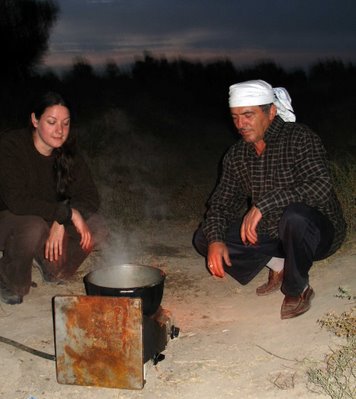
I've made it twice since, back at home, and it's turned out rather well, despite my being a woman. Apparently men alone can cook truly great Plov. The most difficult thing about it is the rice. Underdone or overdone, the dish fails. But if it's done right, this is The Greatest Dish in The World. Not the most complex, or the most extravagant. But the kind of dish you can march a hundred miles and conquer civilisations on.
Each region in Uzbekistan makes its own species of plov; this is, I believe, a Fergana style plov, although I was told that a whole, uncooked green chili is often added to make Fergana plov a little spicier than the usual. In Bukhara one typically (again, I was told) adds sultanas. Other things can be added for special occasions: saffron, for example, or quince.
Plov
You need, for about six people:
Cut the lamb into cubes about an inch and a half square.
Cut the carrots into thin, thin strips the length of the carrot. These should be as thin as you can make them. What you want is a plate heaped full of what look like carrot straws, no thicker than half a centimeter in diameter.
Cut the onions into thin rings.
Pour far too much oil into the base of a very heavy pan (I use an enamel french casserole; in Uzbekistan a giant iron Plov pot). When I say too much, I mean far too much. I reckon two and a half good ladlefuls. Then heat it until it is very, very, very, very hot.
Drop the onions in. Stir with a metal implement. They should fizzle and colour very quickly: you're deep-frying them. Fry them until they're brown, but not crispy.
Add the meat. Fry until properly brown. Depending on your oil's temperature regulation, you may have to rescue the onions and put them to one side to prevent total carbonisation, or you may have to do the meat in batches.
When all the meat and onions are brown (which will look like this):
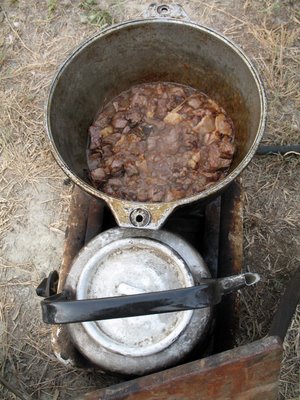
turn the heat down a little and lay all the carrots on top of the bubbling mixture. Just lay them on top, like firewood. Smoosh the cumin seeds in your hand and sprinkle them on top. What you want to happen (and it magically does) is for the carrots to cook there. Not totally, but a little bit. Say seven or eight minutes. You are allowed to poke at them a bit with your flat metal spatula thing, but try not to move them too much: you don't want them to break. I have experimented with putting a lid on the pan to speed this up, but it seems to work both ways.
After they've started softening considerably, add some water to the pan. You want it so that bits of meat and carrots are just poking through the surface. Simmer rather fast for about ten minutes until the carrots are done.
Meanwhile, you wash the rice again and again. You want to get as much starch out as possible. The last rinse but one, use very hot water and soak for five minutes. Then wash again in cold water. I found this par-cooking of the rice helped ensure it wasn't underdone at the table.
Right, here goes. Take spoonfuls of the rice and lay them on top of your mixture. You want a layer of rice. Don't mix it up. Smooth it down.
Take a jug of cold water, and pour it into the pan over the back of a spoon, or a saucer, or your hand. The reason for these objects is this: you mustn't make holes in the rice with the force of the water. Slowly the water will rise and cover the rice with a fantastically oily, orangey (carrots!) broth. The waterlevel above the rice should be as deep as the end joint of your little finger.
Make sure the temperature is a little lower, then leave to simmer. Occasionally, slide a large, flattish spoon or fish-slice along the top layer of rice and turn it over (in sections, of course) so that it cooks evenly. You may feel happier—I did— cooking the rice with the lid on the pot. When you judge the rice is almost done, remove the pot from the heat, and using a flattish, large spatula, pull the rice away from the sides of the pot. Then, using the spoon/spatula handle, poke holes in the pyramid of plov, right down to the bottom. This is to help the plov steam. Double a tea-towel or similar piece of cloth, lay it over the top of the pot, and then replace the lid. Let steam for ten minutes, or so.
Tip it into a huge flat dish, and place in the middle of the table, between your salivating guests.
Everyone gets a spoon and helps themselves from the pile.
Eat with a salad of sliced tomatoes, onion, and salt. With vodka.
A few weeks ago I ate Plov under a tarpaulin in driving rain in an Uzbek desert, and the conversation turned to Plov. Again. I heard that Alexander the Great demanded Plov as a victory feast after each battle. No wonder he conquered the known world. And indeed, I was told then something extraordinary: Alexander the Great invented Plov. Inspired, I insisted that vodka be poured, and constructed a great and detailed toast.
Mumble, mumble....international co-operation....friendship....and well, Alexander the Great may have been the world's supreme military tactician, but now I understand that his martial ability and strategic prowess were but naught, mere trifles, compared to his skill as a cook, for he invented plov, etc. etc. the greatest benefit to mankind, etc. etc.After my grandiloquent speech, and after the vodka was downed, came a worried, quiet aside from my left. "Um, Helen...Alexander the Great didn't actually invent it. His chef did."
I learned to cook this by watching our expedition driver. Here he is making Plov in the Yazimat Steppe, and here I am, looking a little oafish, watching him. Pluvialis, initiate into ancient secrets!
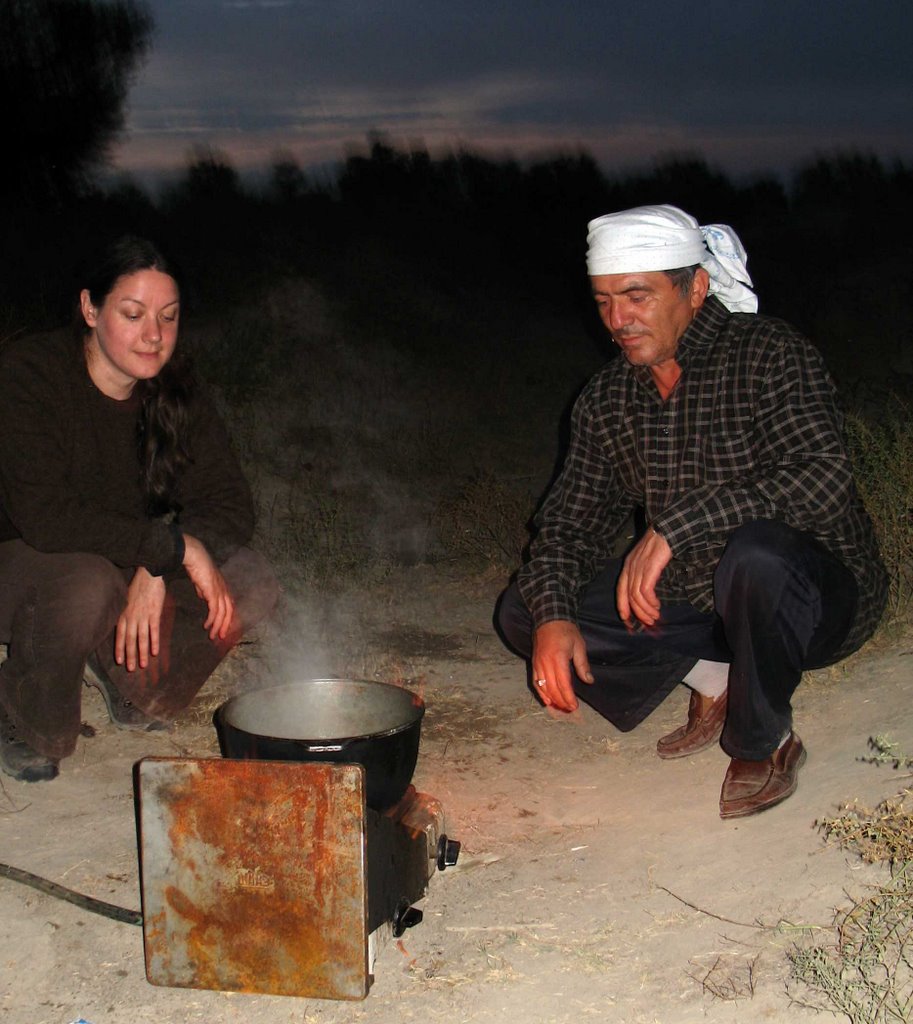
I've made it twice since, back at home, and it's turned out rather well, despite my being a woman. Apparently men alone can cook truly great Plov. The most difficult thing about it is the rice. Underdone or overdone, the dish fails. But if it's done right, this is The Greatest Dish in The World. Not the most complex, or the most extravagant. But the kind of dish you can march a hundred miles and conquer civilisations on.
Each region in Uzbekistan makes its own species of plov; this is, I believe, a Fergana style plov, although I was told that a whole, uncooked green chili is often added to make Fergana plov a little spicier than the usual. In Bukhara one typically (again, I was told) adds sultanas. Other things can be added for special occasions: saffron, for example, or quince.
Plov
You need, for about six people:
- 500g lamb. Flank is good. I used leg steaks, and they were good too. If you can find some bone-in bits, they make it taste even better.
- 500g peeled, topped and tailed carrots.
- ?600g rice. Short grain white rice is best. Quantity approximate.
- Onions. We used long, thin onions, rather like giant shallots, in Uzbekistan, but here I used ordinary brown onions, say two the size of your fist. It worked fine.
- Whole cumin seeds, about a tablespoonful.
- Oil. In Uzbekistan, it's cotton oil. We can't get that here. I tried it with rapeseed oil, and groundnut oil. Rapeseed oil smelt a little grim when being heated, but it worked better. You need an oil suitable for deep frying. One that heats very hot without burning. Olive oil won't cut it for this dish.
Cut the lamb into cubes about an inch and a half square.
Cut the carrots into thin, thin strips the length of the carrot. These should be as thin as you can make them. What you want is a plate heaped full of what look like carrot straws, no thicker than half a centimeter in diameter.
Cut the onions into thin rings.
Pour far too much oil into the base of a very heavy pan (I use an enamel french casserole; in Uzbekistan a giant iron Plov pot). When I say too much, I mean far too much. I reckon two and a half good ladlefuls. Then heat it until it is very, very, very, very hot.
Drop the onions in. Stir with a metal implement. They should fizzle and colour very quickly: you're deep-frying them. Fry them until they're brown, but not crispy.
Add the meat. Fry until properly brown. Depending on your oil's temperature regulation, you may have to rescue the onions and put them to one side to prevent total carbonisation, or you may have to do the meat in batches.
When all the meat and onions are brown (which will look like this):
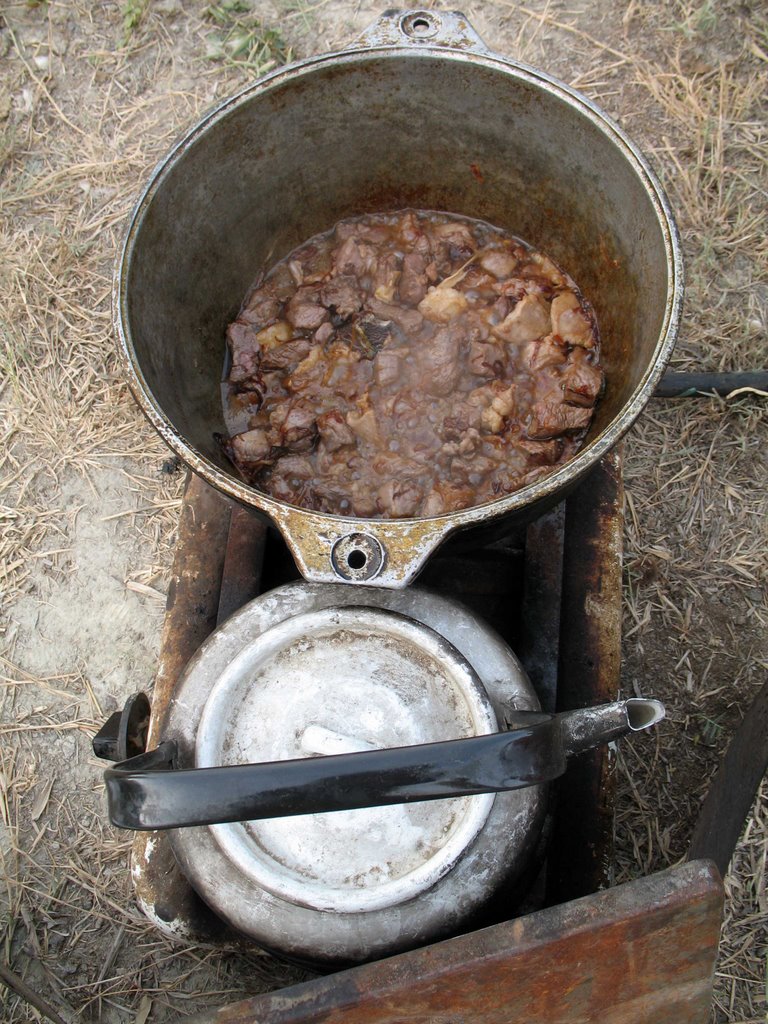
turn the heat down a little and lay all the carrots on top of the bubbling mixture. Just lay them on top, like firewood. Smoosh the cumin seeds in your hand and sprinkle them on top. What you want to happen (and it magically does) is for the carrots to cook there. Not totally, but a little bit. Say seven or eight minutes. You are allowed to poke at them a bit with your flat metal spatula thing, but try not to move them too much: you don't want them to break. I have experimented with putting a lid on the pan to speed this up, but it seems to work both ways.
After they've started softening considerably, add some water to the pan. You want it so that bits of meat and carrots are just poking through the surface. Simmer rather fast for about ten minutes until the carrots are done.
Meanwhile, you wash the rice again and again. You want to get as much starch out as possible. The last rinse but one, use very hot water and soak for five minutes. Then wash again in cold water. I found this par-cooking of the rice helped ensure it wasn't underdone at the table.
Right, here goes. Take spoonfuls of the rice and lay them on top of your mixture. You want a layer of rice. Don't mix it up. Smooth it down.
Take a jug of cold water, and pour it into the pan over the back of a spoon, or a saucer, or your hand. The reason for these objects is this: you mustn't make holes in the rice with the force of the water. Slowly the water will rise and cover the rice with a fantastically oily, orangey (carrots!) broth. The waterlevel above the rice should be as deep as the end joint of your little finger.
Make sure the temperature is a little lower, then leave to simmer. Occasionally, slide a large, flattish spoon or fish-slice along the top layer of rice and turn it over (in sections, of course) so that it cooks evenly. You may feel happier—I did— cooking the rice with the lid on the pot. When you judge the rice is almost done, remove the pot from the heat, and using a flattish, large spatula, pull the rice away from the sides of the pot. Then, using the spoon/spatula handle, poke holes in the pyramid of plov, right down to the bottom. This is to help the plov steam. Double a tea-towel or similar piece of cloth, lay it over the top of the pot, and then replace the lid. Let steam for ten minutes, or so.
Tip it into a huge flat dish, and place in the middle of the table, between your salivating guests.
Everyone gets a spoon and helps themselves from the pile.
Eat with a salad of sliced tomatoes, onion, and salt. With vodka.
Monday, November 06, 2006
Christmas is coming
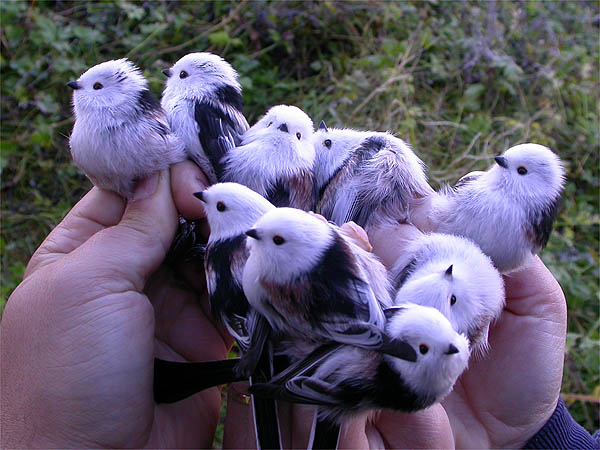
I can't remember where this picture file came from. Apologies for any copyright infringement.
....A handful of northern long-tailed tits at a ringing station...
....A handful of northern long-tailed tits at a ringing station...
Sunday, November 05, 2006
Ghost Stories of an Antiquary
I stay in a College Fellow's Guest Room when I use the Oxford libraries. It's always the same room. I have read the peerless ghost stories of M.R. James, yes. And while I'm not the kind of person who watches Most Haunted or crosses myself when I see a magpie, there's something seriously creepy about this particular room. I wake with horrendous indigestion every single night I sleep there. And when I'm not desperately searching for antacids in my suitcase, I have the most disturbing dreams. Vivid, apocalyptic, murderous, despairing dreams. Not my normal cheerful hullo clouds hullo sky dreams.
No, really. Listening to people's blow-by-blow accounts of nightmares and bad acid trips is the most tedious thing in the world, but just to get across the unnecessary weirdness, here's a bit of one dream.
I walk out into my garden. All the grass has gone. Instead, there are drifts and heaps of riverworn, dry pebbles. I pick one up and look carefully at it. It has distinct growth rings, like a tree. All the pebbles have them. A flock of sandgrouse are foraging in the pebbles and they have the same odd patterns all over their plumage. They all take flight, explosively, in alarm, and as they fly up into the sky, I think they're taking all the water with them, and the sky starts to darken because the world is ending.
Fun, eh? What a cheerful death dream. And that was a mild one. They scared the bejesus out of me. So after a few nights of indigestion and apocalypse, I'm glad when they tell me they must move me to another room; a twin room next door. Someone else needs the single room, they said. Good luck to them, I thought.
This new room was cheery and much calmer. Wooden casement windows that look down on the quad, a mirror, old prints on the walls. But there's a mystery door near my bed. It's locked. Very C.S. Lewis. There's a wide gap at the top, and light spills over into my room. Strange, I thought. Hey ho.
I went to bed early that night, and woke to the sounds of a cocktail party. Animated voices, laughter, toasts. People milling around under my window. I rolled over sleepily. Later I realised there was a hard frost outside. Realisation struck like a slap on the forehead. The door next to my bed led onto the Senior Common Room. The wall was thin. The voices were loud. It was like trying to sleep under a restaurant table. It was interminable. At about 2am I heard muttered goodbyes, a dread, Woosteresque titter, and then three younger voices, presumably exactly my equivalents, uttering, with a whoop, "Gosh! We're the senior fellows now.... we're the senior fell-ows, we're the senior fell-ows"
Talk about holding a dark mirror up to my life. Next time in Oxford I'm staying with friends.
No, really. Listening to people's blow-by-blow accounts of nightmares and bad acid trips is the most tedious thing in the world, but just to get across the unnecessary weirdness, here's a bit of one dream.
I walk out into my garden. All the grass has gone. Instead, there are drifts and heaps of riverworn, dry pebbles. I pick one up and look carefully at it. It has distinct growth rings, like a tree. All the pebbles have them. A flock of sandgrouse are foraging in the pebbles and they have the same odd patterns all over their plumage. They all take flight, explosively, in alarm, and as they fly up into the sky, I think they're taking all the water with them, and the sky starts to darken because the world is ending.
Fun, eh? What a cheerful death dream. And that was a mild one. They scared the bejesus out of me. So after a few nights of indigestion and apocalypse, I'm glad when they tell me they must move me to another room; a twin room next door. Someone else needs the single room, they said. Good luck to them, I thought.
This new room was cheery and much calmer. Wooden casement windows that look down on the quad, a mirror, old prints on the walls. But there's a mystery door near my bed. It's locked. Very C.S. Lewis. There's a wide gap at the top, and light spills over into my room. Strange, I thought. Hey ho.
I went to bed early that night, and woke to the sounds of a cocktail party. Animated voices, laughter, toasts. People milling around under my window. I rolled over sleepily. Later I realised there was a hard frost outside. Realisation struck like a slap on the forehead. The door next to my bed led onto the Senior Common Room. The wall was thin. The voices were loud. It was like trying to sleep under a restaurant table. It was interminable. At about 2am I heard muttered goodbyes, a dread, Woosteresque titter, and then three younger voices, presumably exactly my equivalents, uttering, with a whoop, "Gosh! We're the senior fellows now.... we're the senior fell-ows, we're the senior fell-ows"
Talk about holding a dark mirror up to my life. Next time in Oxford I'm staying with friends.
Friday, November 03, 2006
Scintillating discrete angels
That’s what I’m reading about today. I’m in the Alexander Library of the Edward Grey Institute, part of the Zoology Department of Oxford University.
Phew.
It’s a second home to me, but I don’t get here as much as I’d like. The journey from Cambridge to Oxford is god awful, really it is. You choose between a train journey via London, or a coach journey that takes longer than flying from Boston to London. I collared the driver, once. I came over all selfrighteous and unfolded my timetable and pointed my finger at the floppy paper and demanded an explanation from the driver.
"Look! It says two and a half hours on this timetable!"
"Yeah". He was so cool. "You don't want to pay any attention to that, love, it's rubbish. They don't know what they're talking about".
Downstairs at the EGI is a cracking research library, all 1970s wooden tables, yellow striplights, grey metal shelving. I'll take some sneaky pics today—wow, yes, brace yourselves: doesn't it sound exciting?! Bear with me — trust me on this, it's really pretty awesome.
 The Library!
So yesterday, in a paper on radar ornithology I read the most bewitching passage. It describes the movements of storm fronts and migrant birds. At this point, of course, no-one knew what these radar plots were, nor what was happening on the screen...
Here it is:
Phew.
It’s a second home to me, but I don’t get here as much as I’d like. The journey from Cambridge to Oxford is god awful, really it is. You choose between a train journey via London, or a coach journey that takes longer than flying from Boston to London. I collared the driver, once. I came over all selfrighteous and unfolded my timetable and pointed my finger at the floppy paper and demanded an explanation from the driver.
"Look! It says two and a half hours on this timetable!"
"Yeah". He was so cool. "You don't want to pay any attention to that, love, it's rubbish. They don't know what they're talking about".

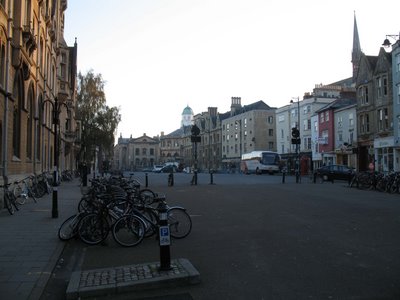
Creepy old Oxford...
Downstairs at the EGI is a cracking research library, all 1970s wooden tables, yellow striplights, grey metal shelving. I'll take some sneaky pics today—wow, yes, brace yourselves: doesn't it sound exciting?! Bear with me — trust me on this, it's really pretty awesome.
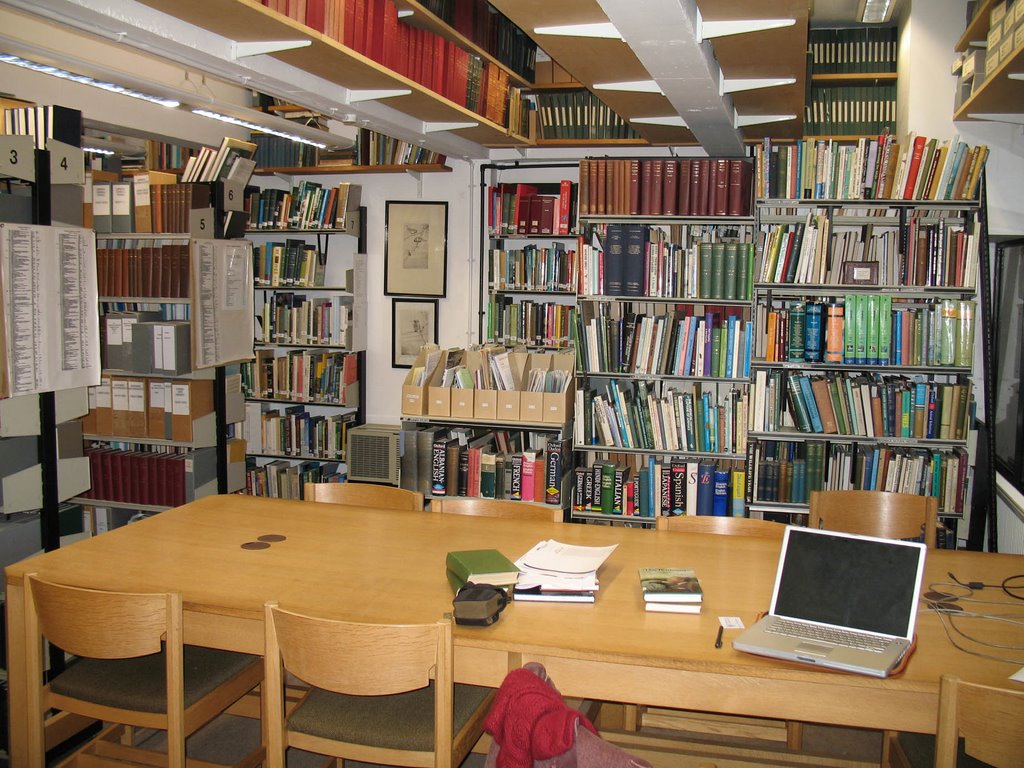 The Library!
Here it is:
The line first became evident at about 1200hr along the coast near Felixstowe; it then moved inland, increasing in intensity and accelerating gradually until sunset, by which time it had reached nearly 50 miles inland and was moving at 6 knots. A similar line developed over Kent and Sussex, moving inland in a similar way. The whole phenomenon decayed rapidly over the sunset period 1930-2000 hr.
Scintillating discrete angels could be seen breaking away from the line during its strongest period; on the easter side of the northern segment over Hertfordshire and Suffolk, and from both sides of the Sussex segments of the line.
In addition to the line echo the screen was well covered with discrete angels during this day. Most were of the short-lived, or rapidly scintillating kind, and these showed no obvious pattern of movement. However, a well-marked stream of persistent angel echoes could be seen moving up the Thames estuary, and some of these could be tracked for considerable distances, occasionally even across the line echo.
Subscribe to:
Posts (Atom)