Tuesday, July 31, 2007

They all come here...how do they find me?


I found this insensibly sad missive, folded tightly, on my hall floor this morning. Why this person, or their agent, decided that I was the person who needed to read this is not only beyond my ken, but it is freaking me the hell out. Lancashire is not even remotely near Cambridge.

I redacted the name and address. Don't want anyone accusing me of fostering further paranoia. I do hope the NHS mental health professionals, for all their resemblance to corrupt G-men on a mission, manage to help this poor person.

Again: why my house?

Pass the tin hat.

This is going to be


Absolutely insane. I can't wait.

(The Worshipful Company of Pattenmakers' motto, there under the shield of shoes, reads Recipiunt Fœminæ Sustentacula Nobis. Which translates as "Women Receive Support From Us". Superb).

Monday, July 30, 2007

The Gorge is Rising

I am spitting chips and blood. I am crackling with furious static. Any minute now, small pieces of paper, coins and pens are going to drag themselves across the tabletop, bent and pulled towards me by the immense, bending-the-laws-of-physics fury I'm experiencing right now.

Why?

I'll tell you why.

This is why.


Hateful!

Let's set it in America?
Let's get rid of "all the Arthurian and Pagan stuff"?
Let's give Will Stanton a twin brother, stolen by the dark?
The Rider a love interest?

In the immortal acronym scribbled on a supervision script by my friend Charles: JHC WTF?

I'd hoped they'd film it one day. I'd hoped for a Sky tv überfest. Like The Hogfather. Filmed on location! Blam! Avebury! The Chilterns! Windsor Great Park! Money thrown at it! They might have had problems finding kids with posh accents to fill the roles, but hey. It would have rocked my world.

I *loved* these books as a child. I must have read The Grey King a billion times.

I am betrayed! The bastards!

Ok, so Christopher Eccleston as the Rider is a stroke of genius. I accept that.

But Ian McShane as Merriman Lyon? Oh no, oh no it doesn't work. I forgave him for Lovejoy, by virtue of Deadwood. But I've just read this, and I'm never, ever forgiving him for it.

I don't think they've been very faithful to the book. I don't know how many of you've read the book. I know they sold a few copies, but I couldn't read it very well. It's really dense. It's from the 70s, you know?

Update: Just read an interview with the guy who wrote the screenplay. I am now convinced I'm living in some alternate reality. This either doesn't make any sense, or it's the stupidest thing I've ever read. And I'm not feeling charitable.

Setting it in the real world, ‘The Dark is Rising’, does that allude to any happenings that are going on now?

Well, if you want, but I mean it was written in 1970 so maybe there was an oil shortage threatening in the early '70's as well. So nothing's changed there. If you'd been making it in the '70's, you'd have to come from unpopular war. No, I mean, you could reel all that into it, but I think that would be laying too much on the film. I mean it's aimed at its audience, and I hope that there's something in it for other people.

God preserve these people if I ever get within striking distance.

Saturday, July 28, 2007

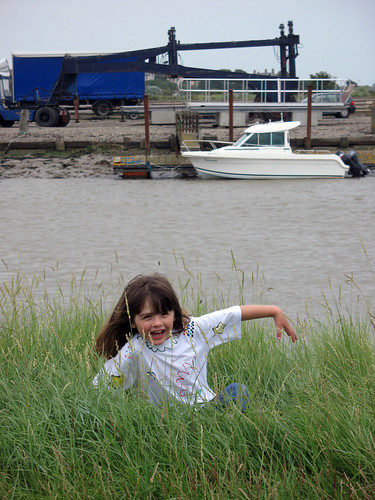
Holiday snaps


Happy child, originally uploaded by pluvialis. Click here for more...

Wednesday, July 25, 2007

If you happen to be interested in Soviet aircraft...

Top post by Reid Farmer at Querencia here.

Somewhere in my dad's files — I'll see if I can dig it out — is an awesome photo of the terrifyingly massive An-225 flying low over a pub roof on the perimeter of Farnborough airport during the 1990 airshow. It hung in the sky, as Douglas Adams would say, in much the same way bricks don't.

Which reminds me:

Plain tales

News this week: a Great Bustard has laid a clutch of eggs on the Plain! An infertile clutch of eggs, but eggs just the same. Huzzah!

I visited this bustard project last summer. I'm embarrassed to admit it, but it made me feel old. Because there was a caravan at the release site, and living in it was a species of person I’d not seen for years. Eager youngsters! Would-be ornithologists! Baby bustard enthusiasts! All lanky and curly-haired in overalls and wellingtons, happy to live in the middle of nowhere, on practically nothing, doing everything: six-hour stretches staring through telescopes at lucerne fields; slapping creosote on duckboards; building aviaries; shooting foxes. I used to be one of these people.

It was hawks, not bustards, in my case of course. Oh, those midsummer nights in a damp, mouldy caravan at the top of a hill. With a copy of the Brothers Karamazov (50p from the local Oxfam shop), a packet of cigarettes, and cans of coke in abeyance of a kettle and instant coffee. Up until 11 making sure they all came in to roost, up at 2 ready for dawn. It has the distinct clarity, this memory, of a bad nightmare. I read the same pages over and over again, trying to make sense of the plot while my poor overtired eyes burned. And thanking the skies that it was a still morning. On windy days, the adrenaline hit was massive: I had a well-founded fear not only of the hawks blowing away downwind — but of the caravan blowing down the steep hill. There was still a visible deep double rut from top to bottom of the hill from the time the landcruiser didn’t quite manage to do the thing they do easily in adverts, and instead slid backwards down the hill to crash backwise against the sheep fencing.

Back to the bustards. The Plain is pretty much the largest piece of grassland range left in lowland Britain. It is a really rather magic place. It has a long, long falconry history. And just as long a history as a magnet for pagans and squaddies. A cultural historian would probably call it a heterogeneous social landscape. Which means, a lone figure walking across a bit of The Plain could as easily be a farmer as a pagan on pilgrimage, a dog-walker, a poacher, ecologist, RSPB liaison officer, ferret-man from Faberstown, long-dogger, Great Bustard reintroduction fieldworker, model aircraft nut, archaeologist or a lost truckdriver. Or falconer, of course. I flew a merlin here years ago, in this paradisical landscape crossed by tank tracks and dotted with unexploded ordnance signs. Flooded leys, long hayfields full of toadflax and blue butterflies, heaps of partridges, lapwings, skylarks, quail. There were disadvantages: flying a merlin on an active DZ, for example, brings helicopters in to have a look, just as flying a falcon on an upland moor brings in wild peregrines. Most offputting.

Most offputting of all, I suspect I oughtn’t to have been flying on The Plain at all. Years later I was told—although this may not be true— that my host didn’t have permission to fly hawks on some of these tracts of land. I don’t know whether this was the case, but I did know, even then, that gamekeepers don't usually shout at you and then walk up to you with a shotgun lowered to the horizontal.


The A303 is the road to the Plain. There are few roads in Britain upon which you are guaranteed to overtake at least one tank-transport convoy, and fewer still where you can peer through roadside plantations of beech and ash to see vast bulks, huge, anonymous rectangular objects covered in camouflage nets. Time and tide. You know, I’m finding such sights unsettling these days. I used to find the coincidence of, say, a ten-thousand strong flock of lapwing and the Ludgershall MoD vehicular depot oddly pleasing. Hmm. Anyway, if you peel off the A303 at Andover, go on to Dunning’s corner, just past the Weyhill fair made famous by Thomas Hardy (and now a long, low white wall with “Weyhill Fairground: Craft Fair!” banner on it), drive through Ludgershall and then take a sharp left once you hit Salisbury Plain, you end up, after a long sail through the Plain and myriad villages, in Marlborough.

Just after my trip to the Bustard Project last year, I visited a farm on the Marlborough Downs. No military presence here, but the Downs have a functional equivalent: racing. Fewer encampments and razor-wire: far more gallops and cross-country courses. This thin, stony soil was farmed by bronze age farmers; then it was sheepwalk for centuries, and only in the last fifty or sixty years has much been ploughed. I remember a short, rattly field of linseed, to the left, as we drove up the hill. And then cresting the rise, saw the land sink below us and then rise on the far side of a huge dry grassy downland valley.

This thin, stony soil is like white paste, it’s so thick with chalk. It’s all hair roots and flints and tiny buttons of stone and impasto. And all over it, stranded at various depths, so they rise and hit harrows and ploughs, are sarsens. They look like burned bones; bulky white bones with dark linear scooped sections, and charred patches and broken edges. And then we met the estate manager. Checked shirt, tan, languid etonian accent, talking about quail (lots), corncrake (the occasional), corn buntings (everywhere) and hares. Hares! Hares hares hares. I have never seen so many hares. The size of donkeys, almost. Lolloping along the dry tracks in front of us, or visible only as HUGE black-tipped ears sticking out of green wheat. "We like the hares" he said. I did too.

One of these adjoining farms was apparently a Templar preceptory, way back when. Estate manager told us that a "very strange stone" was found there, a shallow declivity running its entire length.
“Like a basin, for sacrifices or wine-treading. Or washing, I suppose.”
He thought for a moment.
“It’s bath stone, though: bloody hard. You try and drill it. In this stone they found, there’s a hole in the shape of (and he draws a little picture in the air with his finger) a pentangle running right through the stone. Eight, ten inches. Amazing.” He considers. “Those Templars really, really knew their stuff.”

It is refreshing as hell to meet and talk with people who are nothing whatsoever like the people I see every day. This was the kind of chap you just don’t find haunting the University Library. I think we should encourage a reintroduction programme of non-academic types into this university town. And perhaps someone could hack back some of our elderly dons from caravans on the Plain.

Tuesday, July 24, 2007

Bastards!


Back from the sea, briefly, to discover my next-door neighbour has employed some jobsworth gardeners to get rid of all the passionflower vine tendrils that fell from my garden — where it's rooted — over his own. They decided the best way to do this was take huge handfuls and pull. Unfortunately, this has snapped the one stem that made my bathroom glorious; the one I've trained all over the window, and that made the room soft, and green, and submarine and slightly spooky. I was getting used to flowers, every day, in the bathroom. And it made bathtime tropical in a way no "rainforest flowers" bubblebath could do. Now it's wilting, and I'm feeling unusually vengeful. Ideas?

Apologies for photographs of my bathroom, but I wanted to take some record shots before it disappears completely. Sigh.

Saturday, July 21, 2007

Best coffee in London


May be found at Ray's Jazz Café, upstairs in Foyles. Sublime. Best relaxing birthday lunch? Rules. Best birthday treat for Xtin? London Zoo. Splendid day. Pics on Flickr...click to view and envy.

Thursday, July 19, 2007

Ack!

Meeting with a reviewer for an extremely esteemed literary journal tomorrow because he is reviewing the new William Gibson novel and wants to pick my brains about the man's oeuvre. Blimey. I am going to have to spend the afternoon speed-reading the lot. Cue hot bath, a pile of paperbacks, and a large cup of Yorkshire Tea.

Tuesday, July 17, 2007

Monday, July 16, 2007

Festival


I ought to say that I was in no fit psychological state to go to this Festival, but I went anyway, even if did spend quite a significant (and embarrassing) proportion of my time there curled in a foetal position in the shade under the crown oaks behind the tents. I thought I was going to go with the boy, you see. And of course I didn't. Instead, I made Xtin's life a misery. Sorry, Xtin.

But anyway. It was a crazy hybrid, this Festival, of the Game Fair cut with the 1927 Pageant of Empire at Wembley Stadium, or the Royal Tournament cut with a School United Nations meeting. And of course, the falconry displays were terrible. They always are. You always get some woman—who may or may not be wearing a wimpole—legging it off to the nearest copse, swinging a lure, while the falconer in the arena spins some incredible tale about why today, of all days, the falcon chose to sit in a tree/rake downwind/bugger off entirely.

Oh, there were shed-loads of goshawks, which was rather aggrieving considering my gosless state. A soft-plumaged baby imprint tiercel with stars of down adhering to his wing-coverts sitting on his haunches, draping his wings over the edge of the perch because their new-found feathery heaviness was clearly exhausting. I'd forgotten how expressive goshawk faces are. Faces, not eyes. Gos eyes are baleful, lambent and as remote from emotion or meaning as a metal dish or a patch of sky. But around their eyes, along their lores, hundreds of tiny hair-like feathers flex and raise and furrow exactly as if they were frown lines, and I rememebered my friend Erin telling me how the Naxi falconers he met in China didn’t weigh their hawks to assess their readiness to hunt, but simply looked at the expression on their faces.

There was also one magnificent, huge, powdery imprint Finnish female gos who sat like a bloody god of leopards on one falconer’s fist. She might have been the most beautiful thing I have ever seen. Any coincidence of ease, beauty and ferocity is a bit of a gimme, I know, but her owl-like head and her sleek front feathers with their teardrop slashes all covered in a plummy bloom held me absolutely spellbound. I wanted to look at her all day. She just wanted to look. At everything.

Other sights! A little Arabian fort made of lath and plaster, with a crenellated top and a flag. A little bit of desert, fringed with cut reeds. A climbing cliff next to the DEFRA stand ( to teach dodgy falconers how to climb to peregrine nests? The mind boggles). Camels munching hay. Muscly black and cream Arabian salukis and feathery gold english ones with graceful necks in wide leather collars. There were campfires and carpets, and Turkmen falconers in vast Turkmen wool hats, and Japanese falconers, and painted screens, and borzois, and Emiratee falconers pouring bedouin coffee for slightly baffled festival-goers. It was insanely strange.

Of course, partly that was because I was kind of insane, that day. Lots of things happened that made very little sense, either on their own, or in concert. The car that drew up next to mine, amongst the thousands of cars in the grassy carpark, was that of my old friend John, whom I worked with many years ago when he was researching geese and falcons in the high arctic. I guess the passive smoking of a vast amount of incredibly strong skunk as we sat downwind chatting to another old falconry friend, didn’t help with the weirdness. Slightly spaced, and certainly half-mad, I met with old colleagues and friends; impossibly important Arab VIPs, retired officers from Pakistan, ex-pat vets, old-school falconers, bookmen: indeed, the whole gamut, from royalty to gangsters. I love falconry.

The worst moment of the fair, though? Indubitably the golden eagle. A tiercel, but still with killing talons the size and thickness of your index finger, sitting on a bow-perch. He was very chilled. His plumy hackles blew in the wind as he loafed, cocking an eye up to the thermally sky to watch kites, swallows and hobbies passing through, far above. He was surrounded by people, and even I was impressed by how utterly unconcerned he was. A photographer kneeled three feet from his broad mailed chest, pushing a macro lens into his face. About five inches from his face. Wow, I thought. That’s probably not that advisable, because the eagle’s leash gives it, oh, a good five feet leeway. I have been grabbed by an eagle. When you are grabbed by an eagle – mine was by the shoulder – you actually cannot do anything. You become entirely helpless. Not only because an eagle is stronger than you, but because shock cuts in almost instantly. You understand, these birds kill wolves. Read that again. They really do. And deer.

So as I watched this photographer, I was faintly nervous. Another camera appeared, and got even closer. The eagle looked a teeny bit less relaxed. And then, with a shock as if I'd put my hand into a plug socket while jumping waist-deep into an icy pool, I watched a tiny, fair-haired, not-very-good-at-walking eighteen-month old child walk unsteadily between the eagle and the photographer, brushing the front of the eagle as it did so. The eagle started in surprise, and leaned its snaky head forward, hackles risen, to clop at the child. It didn’t mean to touch the child, and it didn’t, but it was a mite hacked off. And I felt sick and dizzy. If the eagle had done what it might have done—grabbed the child—which would to it have been as rapid and as easy as someone putting out a hand to pick up a cup of tea, the child would have been dead in seconds. No-one seemed to notice, or see what had happened. For god’s sake, what is wrong with people? No-one would let a tiny toddler walk in front of a leopard, or a lion? Or would they? When I was in South Africa, many years ago, I visited a game farm where they bred King cheetahs. Which paced the fences, watching the crowds. You’d see families with small kids walking along, and a cheetah pacing elegantly along, just the other side of the chainlink, in step with the smallest and weakest child, eyes fixed, locked on them. “Look, Thomas!” I heard one woman say in delight. “The cheetah likes you best.” Christ.

Wednesday, July 11, 2007

This rocks!

All sorts of things get stuffed into my College and Departmental pigeonholes. Some get piffed into the wastebasket instanter. Others get arranged into 'to do' piles in the hope they'll disappear. Some things are good.

I get bills, letters from publishers, institutions, copies of mycology magazines, book catalogues, postcards, invitations to this or that. At the end of term such things are joined by much nicer things: gifts from students saying thank you for their supervisions. Bottles of wine are much appreciated, by the way. Chocolates too.

The best of all are presents that relate to the subject I've supervised. A tiny, glossy porcelain penguin, for example, a gift from a Masters student I'd supervised on the media/religion debate over March of the Penguins, still sits on my office mantelpiece, looking quite at home on the chipped white gloss of the shelf.

But this is the best present ever. I supervised this student for his Masters' dissertation, which dealt broadly with the subject of the technological aesthetic and the concept of the technological sublime in an American context, and contained some rather beautiful analysis of that extraordinary poem by Hart Crane, To Brooklyn Bridge. You know the one? It starts:

How many dawns, chill from his rippling rest
The seagull's wings shall dip and pivot him,
Shedding white rings of tumult, building high
Over the chained bay waters Liberty--

Then, with inviolate curve, forsake our eyes
As apparitional as sails that cross
Some page of figures to be filed away;
--Till elevators drop us from our day . . .

I think of cinemas, panoramic sleights
With multitudes bent toward some flashing scene
Never disclosed, but hastened to again,
Foretold to other eyes on the same screen;

And Thee, across the harbor, silver-paced
As though the sun took step of thee, yet left
Some motion ever unspent in thy stride,--
Implicitly thy freedom staying thee!


Today I met this student for lunch and he gave me a little parcel wrapped in soft, printed Japanese paper. I unwrapped it, and a stone fell out. This.


It was his very own, home-made clay cuneiform tablet, upon which he had written -- translated into Akkadian, the lines "The seagull's wings shall dip and pivot him". Or "coast bird" because that was the closest, according to our department's resident expert in the history of mathematics and Iraqi archaeology. She had helped him write it, translating the lines and correcting his cuneiform script.

I love it. It is on my mantelpiece. It will last forever.

Tuesday, July 10, 2007

Pluvialis

Create your own Simpsons avatar here

Friday, July 06, 2007

Logos


Came across this advert in a train company magazine. Let's zoom in on the logos next to the sentence "Our 20 day program is externally accredited and recognised by the leading professional organisations in the field"...


'A recognised course'?

Brilliant.

Tuesday, July 03, 2007

Books not to read....part one


If I had to sum this book up in a word? Creepy. It's a multipurpose volume: first, a manual on how not to keep owls, and second, a giddying window into the psychopathology of a 1950s public schoolboy. It ends with our Etonian giving his owls "female hormones".

Oh, the horror. I wonder what happened to them all. Here are some snippets....
"Putting them to bed was quite the most exhausting task of the day, since as soon as the lights went out at 9.45 I had to rely on my torch. The owls knew very well that this was not adequate, and there would be a mad chase around the room. They either ran on their flat feet or, when they could, flew. They found the most original hiding places, like under the grate of the fireplace, or in my cricket boots. When found or caught, there would be a volley of piercing squawks and they would scratch until blood and bad language flowed quite freely. Sometimes if they were lively I would put on a fives glove, make them sit on my protected hand and move my arm vigorously up and down. This cause them to lose their balance and flap their wings. In the end two very exhausted owls would be put to sleep in their cage"

"When they had been at school for a week and were obviously not going to die, the problem of what I was going to call them arose."

"Dee and Dum were always a bit nervous of women, perhaps because they were handled so much by boys"

"A boy in his pyjamas and a bleeding House Master up a tree at night was no usual sight!"

"Sometimes I used to give them worms covered in feathers, which crawled across the table like some strange caterpillar"

"It soon became a nightly sight to see the wild owl waiting for Dum, who had the same habits as Cupid when he visited Psyche...I hated this wild owl at first, with its weird hoot, and was sorely tempted to shoot it on the chimney as it waited for Dum. Why should it come and take away Dum after all the trouble I had taken? Was this justice?"

"Often when my mother held out her bare arm to alight upon they would both land together and begin to fight for the possession of it. One can imagine the state of a delicate bare arm after two owls have been fighting on it"